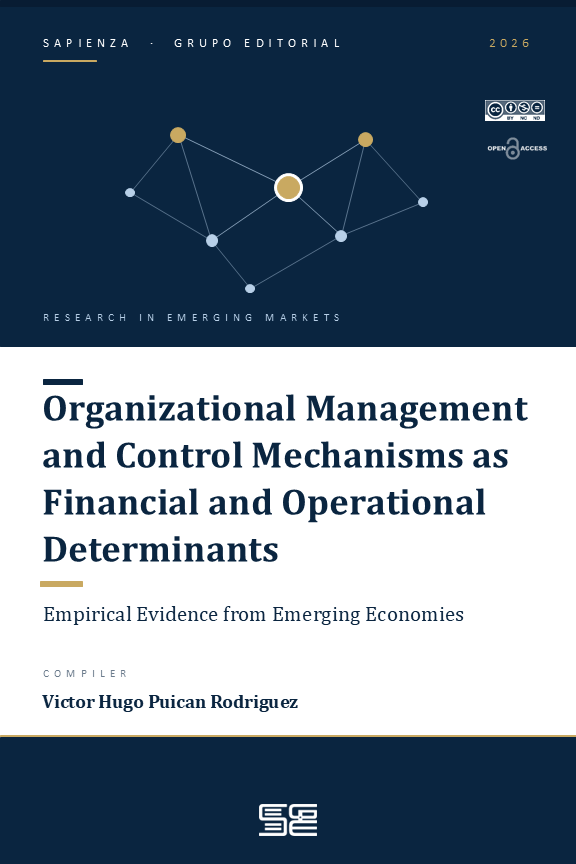
Vol. 8 No. 1 (2026): Organizational Management and Control Mechanisms as Financial and Operational Determinants: Empirical Evidence from Emerging Economies
In recent decades, research in management, accounting, and business administration has generated substantial knowledge on financial, organizational, and operational variables. Yet much of this scholarship remains fragmented, examining profitability, liquidity, internal control, tax culture, and organizational communication as isolated dimensions rather than as interdependent elements of a broader systemic dynamic. This book addresses that persistent gap by advancing an integrated analytical framework that conceptualizes governance and organizational control mechanisms as interlocking drivers of financial sustainability, operational efficiency, and adaptive capacity.
Drawing on a comprehensive synthesis of applied research and robust quantitative methodologies, the volume develops sector-based empirical analyses across diverse strategic contexts, including retail trade, the brewing industry, hardware, pharmaceuticals, fuel distribution, and municipal public administration. Although heterogeneous, these sectors share structural constraints common to emerging economies: limited access to capital, weak control systems, inefficiencies in working capital management, deficient information flows, and governance shortcomings. By examining these contexts comparatively, the book identifies cross-sectoral patterns that illuminate how governance structures and managerial practices shape performance outcomes under conditions of institutional and economic complexity.
Academically, the work contributes to the underdeveloped debate on organizational management in emerging economies by offering methodological coherence, contextual sensitivity, and conceptual integration. It engages with international literature while providing empirically grounded evidence capable of refining theory, testing established models, and informing future comparative research agendas.
Practically, the findings generate actionable insights for managers, executives, policymakers, and public administrators. By demonstrating how supervision mechanisms, financial management practices, and communication processes interact to influence institutional performance, the book offers guidance for designing more transparent, resilient, and sustainable organizational strategies in structurally constrained environments.
Rather than closing theoretical debates, this volume opens new avenues for inquiry, positioning itself as a bridge between rigorous academic research and informed managerial decision-making.